


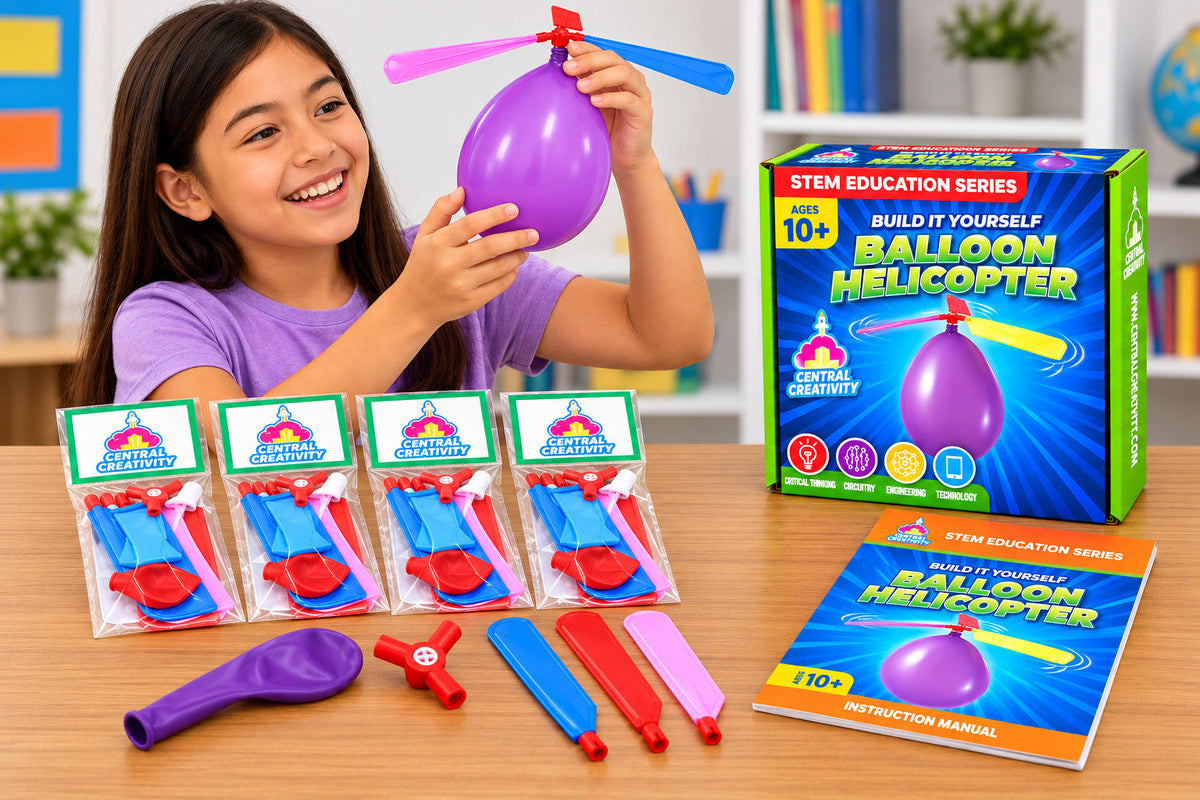

STEM Education Series
Balloon Helicopter Kit (4 per kit)
Four small helicopters driven by balloons. Clip the blades to the hub, fit a balloon to the collar, pump it up and let go — the escaping air spins the rotor, and the rotor lifts the helicopter off your hand.
Nothing to cut, nothing to glue, under five minutes from box to flight. The part worth explaining is that the balloon never pushes the helicopter upward; it only spins it. Everything after that is the angled blades throwing air downward, which is exactly how a real helicopter stays up.
Balloon Helicopter Kit (4 per kit)
The Big Idea
Pump the balloon, slide it into the hub, let go. The air rushing out spins the rotor, and the rotor takes the whole thing off the table.
- Ages
- 10+10+ as printed on the box. Younger with an adult, but read the balloon warning first — that is the part of this kit that needs the supervision, not the build.
- Build time
- Under five minutes
- Physics
- Aerodynamics
- Engineering
- Observation
Safety
- CHOKING HAZARD — children under eight years can choke or suffocate on uninflated or broken balloons. Adult supervision required. Keep uninflated balloons away from children. Discard broken balloons at once.
- This activity contains small parts that pose a choking hazard. Keep out of reach of small children.
- Do not aim the helicopter at anyone. It leaves your hand fast and does not go where you planned.
- Adult supervision and safety glasses are recommended.

What’s in the Kit
- Propeller blades
- Propeller hub
- Balloon collar
- Balloons
- Pump
What you add
- Safety glasses, which the guide recommends and the kit does not contain
Real-world connection
Why spinning is not what lifts it
A rotor that spins fast lifts nothing. Set the blades flat and you can spin them as hard as you like and the machine sits there. What lifts is the angle.
Each blade is set at a pitch, so as it sweeps round it meets the air at a slant and pushes a slice of it downward. Air has mass, so pushing it down takes force, and the air pushes back on the blade by exactly as much in the opposite direction. That reaction, added up over the whole disc, is lift. A helicopter is not screwing itself upward into the sky; it is standing on a column of air it is continuously throwing at the ground.
This toy gets there in two stages, which is what makes it worth building rather than watching. Stage one: the stretched balloon is storing energy, and when you let go, the rubber squeezes air out through the collar fast. That jet strikes the angled blades side-on and spins the hub -- the same way a water wheel turns. Stage two: the spinning blades, now angled into the air, throw air downward and the helicopter rises.
So the balloon never pushes the helicopter up. It only spins it. Everything that happens after that is the rotor doing the work, which is why the thing keeps climbing for a moment after the balloon has gone slack.

The build
-
Clip the blades
The propeller blades slide onto the hub and click into place.
-
Fit the collar
The lipped end of the balloon collar goes into the neck of a balloon.
-
Inflate and launch
Pump it up, pinch it shut, slide the collar into the hub, hold it with the blades level, and let go.

For classrooms
Four helicopters per kit, so one kit serves a small group rather than one child -- worth knowing when you size an order, because it is the only kit in the series that is not one-per-student.
It takes under five minutes, which makes it the filler activity: the thing you run when a session finishes early, or the opener before a longer build. There is nothing to glue and nothing to cut.
Run it in the biggest space you have and agree the no-aiming rule first. The honest experiment is not whether it flies but how high, and that is where the fractions and data work live: same balloon, more air, taller flight; same air, blades reversed, nothing at all.
One real caution for younger groups. Balloons are the most dangerous thing in any of our kits, and that is not a figure of speech — uninflated and burst balloons are a serious choking and suffocation risk for small children. Count the balloons out and count the pieces back in.
Purchasing for your school or program? Request a quote.