
πŸš€ Free Shipping Over $100 Β· Code BUILD100

STEM Event TO GO

Students are scientists,
not spectators.

A complete family STEM event, shipped to your door. Six hands-on stations, every material, printed signage, a step-by-step guide for every facilitator, and online training that shows anyone how to run it. You pick the date. We have already handled the rest.

Order now Request a quote

The Amazing Animal Features kit box, its six station panels wrapping the lid
  • 6activity stations
  • 150participants per kit
  • 2 hrscome-and-go format
  • 7totes, one per station plus a master resource box

Every school wants to host an incredible STEM event.
The challenge is the details.

Building the right content takes time.

Six standards-aligned stations, each tied to a real STEM career, written and tested at live events.

Sourcing materials means endless lists and last-minute supply runs.

Consumables and reusable station materials arrive organized and clearly labeled.

Preparing your team to lead activities can be stressful.

Each station facilitator gets a full-color, step-by-step Facilitator Guide with the script, the setup, and the background science.

“Tell them you planned it for months. We won’t tell.”

Amazing Animal Features

Six stations. One story running through all of them.

Every station answers a question from What Do You Do With a Tail Like This?, the Caldecott Honor picture book by Steve Jenkins and Robin Page. Thirty animals, six body parts, and six stations that take each one apart and put it in a family’s hands. Stations are banded by grade so a family starts where their child belongs — then wanders wherever they like.

The book itself is not included in the kit. Schools purchase a copy or borrow one from the library; the Coordinator Guide gives three ways to work it into the event.

Station 1 Sensory Exploration kit laid out: station sign, guides, texture cards, scent cards, scent containers and essential oils set

Station 1Grades K–1

Sensory Exploration

What do you do with a nose like this?

Students use their senses of smell and touch to identify mystery scents and match textures to the animals that inspired them.

In the tote

  • Six mystery scent containers and a six-bottle essential oils set
  • Scent cards and photographic texture cards
  • Printed station sign and Station Exploration Guide
Station 2 Animal Movement Obstacle Course kit: animal tracks posters, station sign, track stamp set, track cut-outs and washable paint pads

Station 2Grades K–1

Animal Movement Obstacle Course

What do you do with feet like these?

Families identify animal tracks and move through a four-zone obstacle course mimicking how animals travel in the wild.

In the tote

  • Two Animal Tracks identification posters — deer, robin, dog, rabbit, black bear, raccoon and duck
  • Animal track stamp set, track cut-outs and washable paint pads
  • Printed station sign and Station Exploration Guide
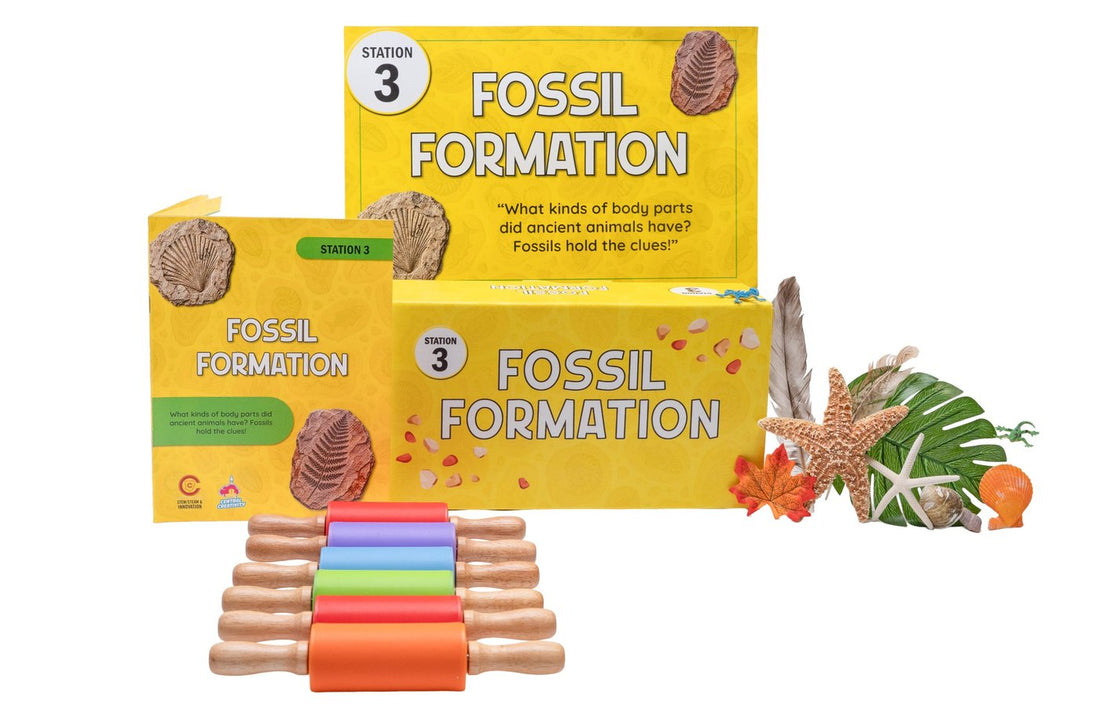
Station 3 Fossil Formation kit: station sign, guide, supply box, rolling pins, shells, starfish, feathers and leaves

Station 3Grades 2–3

Fossil Formation

What kinds of body parts did ancient animals have? Fossils hold the clues.

Students learn how fossils form and create their own clay imprints using shells, plastic animals, leaves and feathers.

In the tote

  • Set of child-size rolling pins
  • Shells, starfish, feathers, leaves and small animal figures
  • Printed station sign and Station Exploration Guide
Station 4 Camouflage Challenge kit: habitat backdrop scenes, station sign, guide and camouflage strategy cards

Station 4Grades 2–3

Camouflage Challenge

What do you do with eyes like these?

Families search for hidden animals in habitat scenes and then design a camouflaged butterfly to blend into its environment.

In the tote

  • Six large habitat scenes — temperate forest, savanna, coral reef, rainforest, desert and arctic snow
  • Strategy cards for background matching, disruptive coloration, countershading, and mimicry and disguise
  • Printed station sign and Station Exploration Guide
Station 5 Cells and Microorganisms kit: Three Shapes of Bacteria poster, station sign, guide, Glo Germ powder with UV flashlight, habitat cards and microbe cards

Station 5Grades 4–5

Cells & Microorganisms

What are all these amazing parts made of? Cells.

Students explore bacteria shapes, match microbes to their habitats, and see germs glow under UV light.

In the tote

  • The 3 Shapes of Bacteria poster — cocci, bacilli, spirilla
  • Glo Germ powder with a battery-powered UV flashlight
  • Habitat cards and six microbe cards, each marked beneficial or harmful
Station 6 Nature's Architects kit: Forces in Nature poster, station sign, guide, animal-builder cards, clothespins, craft sticks, pipe cleaners, binder clips and design record sheets

Station 6Grades 4–5

Nature’s Architects

What do you do with a mouth like this? Build.

Families explore how animals build structures for survival, then engineer their own load-bearing structure and test it against gravity.

In the tote

  • Forces in Nature poster — gravity, compression, tension
  • Animal-builder cards: beaver, termite, weaver bird, paper wasp, leafcutter ant
  • Clothespins, craft sticks, pipe cleaners and binder clips, with a Design Record sheet and Simple Machines Spotter

How an event actually runs

Lifted straight out of the Event Coordinator Guide, which is the document that does the worrying for you. It carries a planning calendar you can run at whatever pace suits you, a promotion calendar, a room layout, three table configurations per station, a setup timeline by the quarter-hour, an optional welcome script, and a post-event checklist.

  1. When the kit lands

    Everything is already in the box

    Seven labeled containers — six station totes and a master resource box. Open each one, check it against the inventory list, and the only things left to buy are the everyday supplies on the short list above.

  2. Next

    Line up your facilitators

    One adult per station, plus a coordinator. Parent volunteers are ideal: the Station Leader Guide carries the script, the materials checklist and the background science, so nobody needs a science background to run a table.

  3. The one step with a clock

    Tell people it is happening

    This is the only part that really wants lead time, and it is your own audience’s calendar that sets it. The promotion calendar maps out what goes out when, and the family flyers and promotional posters are already in the master resource box.

  4. The week of

    Hand out guides, prep two things

    Each Station Leader gets their own guide — one station, nothing else, so nobody reads sixty pages to run one table. Scent containers for Station 1 and clay for Stations 3 and 6 are the only advance prep in the whole experience.

  5. Two hours out

    Setup

    Tables up, totes at stations, check-in table by the doors. Facilitators arrive 90 minutes out and set up their own stations. A 15-minute all-team huddle before doors open, and that is the whole rehearsal.

  6. Doors open

    Everyone else runs it

    No timed rotations, no groups to herd. People arrive when they arrive, check in, and explore in any order at their own pace. Most stay 45 to 75 minutes. Facilitators reset between groups and keep going.

There is no long lead time. The kit ships complete and ready to run. What sets your date is how much notice your own audience needs — not how long we take.

One kit, two ways to run it

The same six stations work as a family STEM night or an in-school field trip. Buy one kit and run either.

Running as a STEM Night

An evening event that brings families into your school.

  • Who it’s forStudents and their families, exploring together.
  • What happensFamilies come and go, visiting stations in any order at their own pace.
  • How longA ½ to 2-hour window.
  • How manyUp to 150 participants.
  • Who runs itYour staff and parent volunteers, one per station. No science background needed.

Running as a Field Trip

A field trip that comes to you.

  • Who it’s forA grade level or grade band, K–5, during the school day.
  • What happensClasses rotate through all six stations in color groups, so every student does every activity.
  • How longAbout 2 hours, including arrival and six 15-minute rotations.
  • How manyUp to 150 students.
  • Who runs itYour teachers, aides, and chaperones, one per station.
  • StandardsEvery station is aligned to K–5 NGSS and tied to a real STEM career.

The complete experience

$2,500

One kit. Six stations, every material, all printed signage and marketing, seven guides, the digital files, the training videos and a support team — enough for up to 150 participants.

Ready to go? Order it outright. Need it on a purchase order instead? Ask for a formal quote and we will put it in writing — Title I, Title IV-A, 21st CCLC, PTO and family-engagement budgets are the funds schools most often use for this.

Order now Request a quote

Or call 866-381-1760 and talk it through first.

Easy for you.
Unforgettable for them.

Pick a date. We will take it from there.

Order now Request a quote

Or call 866-381-1760